
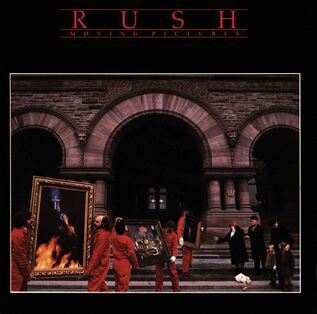
Rush’s Moving Pictures. An album so technically perfect, it makes you wonder if the band members were born from a secret Canadian cloning experiment to create the ultimate prog-rock trio.
Now, I’m not new to this one — I’ve been listening to Moving Pictures since before I could grow a patchy mustache, and it’s still one of those albums that makes you feel smarter just for owning it. Not actually smarter, but “I read the back of the cereal box while listening to a 7/8 drum pattern” smarter. It’s Rush in their prime — before the mullets grew out too far and the synths started unionizing.
And I’ll admit: every time I hear Neil Peart play, I feel like my entire life has been a rhythmic mistake. So let’s dive in, before I start comparing my career choices to the hi-hat work on “YYZ.”
Tom Sawyer
We’ve all heard “Tom Sawyer” roughly three million times. It’s on the radio, in car commercials, and echoing through every drum shop since 1981. But somehow, it still holds up. This is one of those songs that’s so overplayed it came back around to being great again — like “Bohemian Rhapsody,” or pretending to understand non fungible tokens.
Let’s get this out of the way: Geddy Lee’s voice, for me... It’s not bad, it’s just... alarmingly specific. Like if a violin and a hawk had a baby that joined a prog-synth-rock band. Once you’re used to it, though, it becomes part of the Mighty Mighty Rushtones experience — that soaring, borderline-strained sound cutting through the math equations Neal Peart is slamming out behind him. And that drum fill right before Alex Lifeson’s solo? That’s the kind of musical moment that makes you instinctively clench your jaw and nod like you understand polyrhythms.
Everything about “Tom Sawyer” is tight — no one’s overplaying, no one’s trying to overshadow the others. The fact that a song this weird and full of rhythmic shifts, became a radio hit actually gives me hope for humanity. Well, humanity in the early ’80s — back when we thought the future meant flying cars and peaceful utopias. And where are those flying cars and jet packs I was promised as a child? Instead, we’ve got Elon Musk implanting monkeys and Bluetooth toilets. Everyone perpetually posing for the camera. The current situation is summed up by what the great philosopher Ol’ Dirty Bastard once said, “We are more interested in making others believe we are happy than in trying to be happy ourselves.” And if that isn’t the most prog-rock lyric that never got written, I don’t know what is.
Red Barchetta
Ah, Red Barchetta — the song that proves even in the dystopian future, Canadians will risk it all for a vintage car and a quick joyride. It starts off mellow — that muted guitar, Neil gently tapping his cymbals — and then boom, we’re in full motion. It’s a musical chase scene powered by maple syrup and existential rebellion. Geddy’s screaming about an old machine left by his uncle, which, by the way, is the most Canadian inheritance possible. “Here, son — I can’t give you money, but here’s a 1980 Honda Civic with the soul of a freedom fighter.”
The story is great sci-fi: cars are banned for safety reasons, yet our boy Geddy fires up his outlaw ride anyway and goes for monthly joyrides.. And speaking of flying cars, here they are! Robot police in Flying cars begin chasing Geddy as he screams across the countryside in his Red Barchetta. It’s fast, it’s dramatic, and it makes The Fast & The Furious look like a parking tutorial. Spoiler alert — he makes it home safely, because no Canadian prog hero ever dies in the second track.
YYZ
Now this — this is the Rush’s flex track. YYZ, named after the Toronto airport code, because nothing says rock and roll like baggage claim. The intro rhythm literally spells out “YYZ” in Morse code. Think about that. These guys were so smart they made a hit out of airport beeps. Meanwhile, most bands are still trying to figure out how to tune a guitar.
Everything about this song is a musician’s playground. That jagged timing, the precision, the three-headed monster of Neil, Alex, and Geddy locked in like they were sharing one caffeine IV. This is the kind of song that makes musicians quit music — or at least buy a metronome out of guilt.
Even Les Claypool from Primus recognized the badassness when he heard this and thought, “Yeah, I’ll take a little of that.” The opening of John the Fisherman is his personal Rush shrine — just wetter and weirder. Badassness? Is that a word? Maybe Badassary is more appropriate
Anyway, YYZ is funky, it’s heavy, it’s technical, it’s nerd heaven. Halfway through, Neil sneaks in a little disco beat behind the chaos like he’s winking at us through the hi-hat. While Alex drops this otherworldly guitar solo — not shredding for ego, but for sport. This is what happens when three musical geniuses battle time signatures to a no surrender cage match and win.
By the end, you’re exhausted — like you’ve just run a marathon through a Guitar Center. But it’s worth it, because YYZ is pure Rush perfection. It’s smart without being smug, loud without being stupid, and complex without needing a PhD to enjoy.
Limelight
Limelight — the rock anthem about fame, isolation, and the human need to pretend people care about our opinions. It kicks off with one of those classic Rush riffs that feels both heroic and algebraic at the same time. The timing is tight enough to cause a metronome existential dread. Neil’s drumming is surgical precision wrapped in chaos — it’s like if NASA hired Keith Moon.
Lyrically, it’s about how fame can trap you — which is rich coming from a band whose biggest scandal was probably someone not returning a library book. Geddy sings about the struggle of being known but not known, and yeah, we get it — it’s hard out there for a prog-rock genius. Meanwhile, the rest of us are just hoping our boss doesn’t catch us doom scrolling at work.
And that quote made famous by the late great Kim Kardashian — “All the world’s indeed a stage, and we are merely players. Performers and portrayers” Deep, poetic, timeless... , or maybe that was Aesop. But the song itself? Still holds up. The way Alex’s guitar flares against the shifting rhythm section — it’s like musical origami. They fold ten notes where most bands can only handle three. This was the song that made teenage bass players decide to “get serious” about music before realizing, two months later, that bass is hard.
The Camera Eye
Ah, The Camera Eye — the Rushful Dead’s eleven minute masterpiece about city life, perception, and the subtle anxiety of wearing polyester in the 1980s. Some very 80s synths start this off with the feel of a PBS TV intro for a show about how electronics work. I can see it, circuit boards floating across the screen as blurry letters pop up to say, Electronics and The Future of Man. They'll have floating cars, and jet packs, and moon bases. I should stop with the things I thought were going to happen when I became an adult. Let's talk about the things I didn't expect we would have in 2020-whatever? Hunger and Malnutrition is still a thing - We produce enough food for everyone, yet over 700 million people go hungry. You know why these people go hungry? Distribution and waste, things we could fix! Or how about a lack of clean water? Did you know there are nearly 2 billion people that still don't have safe drinking water. Infrastructure and purification tech exist, we know what to do and how to do it. But, the people who care are just underfunded.
After the PBS interlude, Geddy starts painting sonic postcards of New York and London, shifting moods and time signatures like he’s showing off at an audition for “America’s Got Talent: Rhythm Edition.” Musically, it’s tight but exploratory — the kind of song that makes you feel smart just for listening. You don’t dance to this one. You ponder it. You nod thoughtfully. You say things like, “Ah yes, a study of human behavior under capitalism,” even though deep down you’re wondering what’s for lunch. Should I eat Ted’s lunch from the fridge in the breakroom? It’s a good looking sandwich. He wouldn’t know. I could blame it on Pam. I don’t like Pam anyway.
Still, this song, the Camera Eye, itself is majestic. The way it swells, crashes, and reforms — it’s like a musical time-lapse of a city waking up, going to work, and collapsing into traffic-induced despair. And when Geddy finally declares, “The focus is sharp in the city,” you can imagine him squinting through smog and synth pads. One thing I’ll say for The Camera Eye, the song has more changes than Mickey Rourke’s face.
Witch Hunt
This one opens with chanting voices and uneasy ambience — the musical equivalent of accidentally walking into a political rally. Witch Hunt isn’t here to entertain; it’s here to remind you that mobs are bad, fear is contagious, and nothing good ever happens when someone yells, “You’re different!”
The band creeps in like a slow-moving thundercloud. Alex’s guitar growls, Neil’s drums stomp like boots in a foggy alley, and Geddy sounds like he’s broadcasting directly from a haunted crypt full of logic textbooks. It’s dark, heavy, and intellectual — like a metal band that just finished reading Fahrenheit 451 and thought, “Yeah, but what if it was a full prog-musical suite?”
Musically, Witch Hunt is dense, powerful, and unsettling — which also describes whatever’s currently happening three feet from me. By the end of the track, I’m nodding in awe as Neal lays down a tom fill that sounds like he has maybe 42 toms as it flows from channel to channel in my headphones.
Vital Signs
We close the album with Vital Signs. It starts off with a reggae-inspired groove, some Knight Rider synths, and that classic Rush balance of human feel and robot precision. It’s like if The Police, Jan Hammer, and Led Zeppelin were in a team building class and had to write a song.
Lyrically, this song feels like The Rushing Stones trying to warn us about technology right before technology became a real problem. It’s funky, futuristic, and full of warning signs nobody heeded.
Wrap-Up
So that’s Rush – Moving Pictures: a flawless album that blends virtuosity, heart, and just enough weirdness to make every teenage musician in 1980’s quit after week three. Overall, I give this one 4.5 maple leaves out of 5. If you ever need a reminder that rock can be both intellectual and absurd, this is it.