
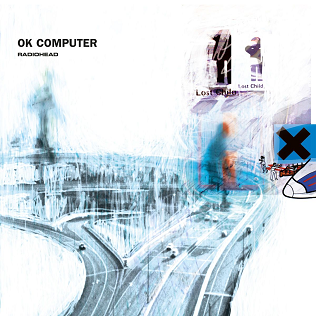
Radiohead’s OK Computer. The album that critics worship like it was found carved into stone tablets and delivered down a mountain while someone mumbled into a reverb pedal. People say it defined the late ’90s, reshaped rock music, and gave birth to a new era of art-rock genius. Personally, I think it sounds like someone left a tape recorder in a laundromat overnight and just rolled with whatever happened.
It’s been hailed as one of the greatest albums of all time, but listening to it, I just kept asking myself: greatest what? Greatest cure for insomnia? Greatest example of a producer burying the vocals out of sheer mercy? Greatest soundtrack for making a grilled cheese sandwich?
So grab a blanket, dim the lights, and prepare to get swallowed alive by distortion, sci-fi noises, and one of the most committed mumblers in music history. This is Radiohead’s OK Computer.
“Airbag” kicks off the album with what I can only describe as a low-energy shrug of an opener. The distorted drums sound like they were recorded through a paper tube, and the guitar noise just kind of buzzes along without ever really committing to being interesting. The singer mumbles his way into the song, half-buried in the mix, singing about surviving a car crash. You’d think this would be triumphant — like he’d be screaming with joy about being alive. Instead, he delivers it with the energy of a man mildly inconvenienced that his favorite sandwich shop ran out of bread.
The song tries to dress itself up with production tricks: weird sci-fi noises, record scratches that sound like someone’s first day as a DJ, and yes — actual jingle bells sprinkled in like it’s Christmas in Radiohead-land. Instead of building into something powerful, it ends up sounding like a grab bag of half-baked ideas. None of it sticks, and all of it feels out of place.
What makes it worse is how joyless it all sounds. If this is the moment where the singer cheated death, why does it come across like he couldn’t be bothered to care? A song about surviving a car crash should feel electric, like your veins are on fire. Instead, it feels like someone took NyQuil before picking up a guitar. If I weren’t reviewing the album, this is where I’d have turned it off and never looked back.
As an opening track, it’s supposed to set the stage for a legendary album. Instead, it warns you right away: “This is going to be slow, this is going to be noisy, and you are going to suffer.” And that warning turns out to be completely accurate.
Paranoid Android
Here comes the “epic” — Radiohead’s attempt at their own Bohemian Rhapsody. “Paranoid Android” clocks in at six-plus minutes, and in that time, it manages to be about four different songs glued together. It starts off with acoustic guitar and light drums, the singer sighing into the mic like he’s already bored with his own lyrics. He claims he’ll be king someday. I’m not sure a guy who sounds this uninterested in being alive is cut out for monarchy.
The song jolts into heavier sections, with distorted guitars crashing over everything like a toddler knocking over blocks. Then suddenly we’re in what sounds like a 1970s Aerosmith jam session, all chunky riffs and strutting attitude. Just as you start thinking, “Hey, maybe this could go somewhere,” it whiplashes back into slow, swaying dirges where monks chant in the background. It drags on and on, like they’re daring you to stay awake.
By the time the last section hits, it’s chaos: screaming vocals, horses trotting in the background (yes, really), and enough noise to make you wonder if the mixing engineer just gave up and walked out of the studio. It’s not cohesive, it’s not clever, and it’s not enjoyable. It’s a collage of random sounds masquerading as genius.
Fans worship this track as one of Radiohead’s defining achievements. To me, it sounds like a band trying every trick they could think of and hoping something would stick. Guess what? None of it does. If this is the crown jewel of OK Computer, I’d hate to see the scraps left on the cutting room floor.
For a brief moment, “Subterranean Homesick Alien” feels like it might offer a break. The opening guitar is dreamy, floating on a syncopated drum groove that almost feels pleasant. The textures are airy and lullaby-like, a small glimmer of hope that the band might deliver something listenable. But then the singer, I don’t know this band other than I think there are 2 brothers in it, and I think they had a hit recently with a song called “Sucker”. Anyway, I don’t know the singer's name, but I’m just going to call him Dopey like the dwarf from 7 dwarves, because he sounds half asleep most of the time. He comes in, mumbling his way through lyrics buried so deep it’s almost as if the producer was embarrassed by his voice.
The song coasts along in this half-asleep haze, never building, never breaking, just floating like a balloon someone forgot to tie down. The vocals are impossible to make out, the instrumentation is repetitive, and the energy level is somewhere between “waiting in line at the grocery” and “taking a nap on Sunday afternoon.” It’s supposed to feel otherworldly, like aliens peering down on Earth. Instead, it sounds like aliens decided to send us their dullest elevator music.
What makes it worse is the total lack of payoff. There’s no big chorus, no surprising turn, no hook to keep you engaged. It just drifts until, predictably, it collapses into nothing. The ending doesn’t resolve — it just gives up, like the band got bored and moved on to the next track.
I’ll give it this: it’s less abrasive than the previous two songs. But that’s only because it replaces the noise with boredom. This isn’t “subterranean” or “alien.” It’s just flat, uninspired, and forgettable. The kind of song that vanishes from your brain the second it stops playing.
“Exit Music” tries to sound important. It starts with distant acoustic guitar strums, as if Dopey is playing in the other room and doesn’t want to be disturbed. His voice drifts in — softer this time, almost tender — but still full of that marble-in-the-mouth mumbling. You can catch bits and pieces of words, but the rest is buried in breathy sighs and reverb haze. It wants to be intimate, but it mostly feels unfinished, like a demo track someone accidentally left on the final album.
Then come the monks. low in the mix, as if we’ve suddenly stepped into the soundtrack of a medieval video game. A warbling keyboard sneaks in too, wobbling like it has low batteries. The build is painfully slow, so slow that by the time a fuzzed-out bass finally enters, you’re ready for something—anything—to happen. Instead, it turns into a wall of distorted sound, muddy and indistinct, burying whatever fragile beauty it might have had under layers of fuzz.
At its peak, the track feels like it’s going to explode into a cathartic release, but instead it just… unravels. Everything collapses back into nothing, ending the same way it began: weak, distant, and unsatisfying. It’s like watching someone light a firework only for it to fizzle on the ground.
“Let Down” is the perfect title because that’s exactly what this track delivers. It starts off with chiming guitars and gentle drums, all moving at the pace of a snail on sedatives. Dopey enters, sounding more bored than ever, as if singing these lines is the most exhausting thing he’s ever done. The mix swallows him whole, burying his voice under waves of guitar delay and plodding bass. It’s like the band wanted to make sure the only thing you don’t hear clearly is the frontman.
As the song goes on, you keep waiting for something to break through the monotony. Surely this is where the big chorus comes in? Nope. Instead, you get the same low-energy verse repeated again, with the tiniest hint of harmony that sounds like it was recorded by accident. It’s the musical equivalent of watching paint dry — you stare at it long enough hoping for change, but all you get is the same dull color slowly spreading.
By the halfway point, the song begins to drown in its own effects. Layers upon layers of guitar, delay, and atmosphere try to disguise the emptiness at its core. It’s all texture and no substance, like wrapping an empty box in shiny paper and pretending it’s a gift. Even the “lift” moments feel forced, like they were copy-pasted into the mix to give the illusion of movement.
The cruel irony is that Dopey actually sounds like he’s disappearing, as if the entire concept of the album is “let’s erase the singer track by track.” By the end, he’s practically a ghost. Which, I suppose, makes sense: if I had to front a song this dull, I’d want to vanish too. Do you think they Jason Newsteaded the singer like Metallica on the And Justice for All album?
If OK Computer has a “hit,” it’s “Karma Police.” You’d think that would mean this song has a spark of life, something memorable to grab onto. Instead, it lulls you in with elegant piano and acoustic guitar, only to immediately drown it in distortion. The beauty that could’ve been there gets buried under another avalanche of noise, turning what might have been haunting into something more like a funeral dirge for ambition.
Dopey’s voice here is especially painful — fragile, whiny, and constantly teetering between “delicate” and “annoying.” He delivers the lines like he’s half-asleep, and when he gets to the chorus, the payoff just isn’t there. “This is what you’ll get,” he repeats, and all I can think is: yes, this is exactly what I got — six tracks of disappointment, and counting.
About midway through, the band tries to push the drama button. The instruments swell, the noise gets louder, and Dopey starts wailing in his signature moan. But instead of lifting the song into something powerful, it just makes the whole thing heavier and harder to sit through. The tempo stays slow, the energy stays flat, and the mood stays firmly planted in “gray.” It’s like slogging through wet cement.
By the end, the whole thing collapses into repetitive chanting and more distortion, as if they’re trying to hypnotize you into believing this was profound. It wasn’t. This isn’t karma catching up with anyone — it’s me catching myself checking the track lengths.
“Fitter Happier” is not a song. It’s my long-lost Speak & Spell resurrected and trying to lecture you about life while someone plays The Disney Halloween sound effects record in the background. The voice drones on about eating well, exercising, and being a good little consumer. The only thing missing is “Don’t forget to drink your Ovaltine.” If this was supposed to be social commentary, it lands about as hard as high school poetry.
The production doesn’t help either. The voice is so sterile it sounds like it’s actually being produced on a 1970s Speak & Spell. Behind it, you get random piano chords and unsettling noises. It’s the kind of thing that could bore you to tears.
What makes it worse is that the band clearly thought this was clever. Like, “Look at us, we’re deconstructing capitalism and modern malaise with a robot voice!” In reality, it’s filler that has no replay value whatsoever. No one — and I mean no one — has ever said, “Man, my favorite track on OK Computer is ‘Fitter Happier.’” That sentence has never been spoken by a human.
If the point was to show how cold and lifeless modern life is, then congratulations, they nailed it — by making the track itself cold, lifeless, and unlistenable—meta art at its worst.
At last! A pulse. “Electioneering” starts with a scratchy surf-rock riff that almost tricks you into thinking the band has woken up. The tempo actually moves faster than a funeral march, which, by this album’s standards, is revolutionary. The drums drive a little harder, and for once, you can almost imagine someone dancing — not well, but still.
But then the vocals come back. Buried, muffled, and whiny as ever, they smother what little momentum the song had. Lyrically, it’s supposedly about politics, corruption, and false promises, but good luck figuring that out without a lyric sheet. All I hear is Dopey mumbling through a megaphone filled with cotton balls.
The breakdown tries to build tension with noisy guitars and a clunky solo that sounds like someone learning scales in Guitar Center after school. It’s chaotic without purpose, loud without bite. You want it to soar into something awesome, but instead it flails around before collapsing back into the same messy riff it started with.
Still, I’ll give it this: compared to the dirges surrounding it, “Electioneering” feels like a shot of espresso in a sea of afternoon television. This song is not good, but at least it’s awake.
This track dives straight into horror movie territory, with reverbed drums and creepy, dissonant sounds lurking in the background. The vocals are so far away they might as well be humming. Dopey mumbles like a ghost trying to deliver a eulogy through a broken intercom system. It’s meant to be unsettling, but it ends up just being boring and muddy.
The problem is that the song takes forever to do anything. For two full minutes, it just drones on with the same atmosphere and plodding rhythm. Then, finally, some distorted guitars and feedback slide in, but instead of adding power, they just make the mix claustrophobic. It’s like listening to a band practice in a basement while you’re standing upstairs.
By the climax, Dopey is screaming, the guitars are screeching, and everything is peaking in distortion. But it still doesn’t hit. It’s messy without being intense, noisy without being cathartic. It sounds less like a carefully constructed build and more like they knocked over some amps and decided to leave it on tape.
And then — like half the songs on this album — it collapses at the end. Just falls apart into nothing, leaving you with the impression that they either ran out of ideas or got bored with their own song again. Honestly, I can’t blame them.
This one opens with plinky little bells and a lullaby guitar line, like a Fisher-Price mobile that’s been left running in a crib for a while. It’s calm, delicate, and immediately suffocating, like being trapped in a dentist’s waiting room that only plays sad toy pianos. Dopey’s voice floats in like a tired ghost who can’t even be bothered to haunt properly. It’s so faint.
Halfway through, the song promises something bigger, but nope — it just keeps plinking away like a metronome. Lyrically, it’s basically Dopey whispering, “Life sucks, I want no surprises.” Which is funny, because the biggest surprise here is that people like this. I get the point — minimalist beauty, restraint, blah blah blah. But it’s like minimalism to the point of starvation. You’re not an artist, Dopey, you’re a guy who forgot to write endings to your songs.
And yet, fans call this one of the “prettiest” songs on the record. Sure, if you find pretty in the same way you find pretty in a pet rock. By the end, I wasn’t relaxed, I wasn’t enlightened, I was just annoyed that I let three minutes and 49 seconds of my life get slowly chewed up by an off-brand music box.
This one starts with more sci-fi noise, like a UFO trying to tune into an AM sports channel. Then a slow guitar line and steady drums wander in, and for once, it sounds like the band might actually write a song. By Radiohead standards, that’s already a miracle. The atmosphere here feels less like “collapsed lung” and more like “guy sighing into a window on a rainy day.” That’s progress.
And when the choir and soaring guitar enter, it almost feels… cinematic. Almost. But it’s like a movie scored by someone who accidentally fell asleep on the synth keyboard. Dopey’s voice is still buried, thankfully, like the producers agreed he should only appear in the mix if he signed a waiver. Lyrically, he’s supposedly talking about survival and hope, but it all comes across like someone reading their will while half-dreaming.
The guitar solo, though, is actually pretty good. It feels like the one time in the whole album someone in the band woke up, stretched, and remembered how to play their instrument. If the rest of the record had this kind of focus, maybe I’d believe the hype. Instead, “Lucky” just proves the band could make a decent track if they stopped making everything sound like it was recorded inside an antique washing machine.
And here it is — the grand finale, if by “finale” you mean a dying turtle dragging itself across sand for six minutes while the sun bakes it. It starts with a slow, mellow guitar line, and then Dopey’s voice limps in like it needs a cane. He keeps repeating “slow down,” which is hilarious, because if this album slowed down any further, we’d be in negative time. Like, it would actually start playing in reverse, and I would unlisten to the previous tracks.
The band tries to build it up, layering instruments and stretching notes, but the tension never goes anywhere. It’s like waiting for a balloon to pop, only to realize it was never inflated in the first place. The song just sits there, brooding, while Dopey croons. It’s not haunting, it’s not moving — it’s background noise for a bank commercial no one approved.
By the end, I wasn’t thinking “wow, what a conclusion.” I was thinking, “That’s it? That’s what all the fuss is about?” You want to know my tourist experience with this album? This is how I felt. I was wandering aimlessly through a city where every restaurant is closed, every museum is shut down, and the only attraction is a busker muttering into a broken kazoo.
So that was OK Computer — the album critics fell over themselves to crown as genius. Sure, there are moments — a guitar solo here, a half-interesting arrangement there — but most of it feels like audio beige. The kind of thing you put on when you want to convince your plants to wilt faster.
People call it groundbreaking, revolutionary, visionary. I call it slow, noisy, and full of a guy mumbling into a pillow while the rest of the band stares at their shoes. It’s not a concept album, it’s an endurance test. Like, “how long can you pretend this is deep before realizing you just spent an hour listening to noise, mumbling, a Speak & Spell recite slam poetry, a broken keyboard, and antique appliances?”
Would I recommend it? Only if you’re into musical self-flagellation. Otherwise, I’d say skip this one. Put on something that actually moves you — or at least remembers to include a melody. OK Computer? More like “OK, I’m done.”