
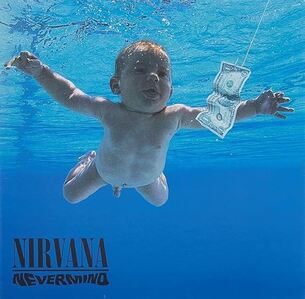
Nirvana – Nevermind
1991, the year hair metal died and flannel took over the world. Enter three scruffy dudes from Seattle who somehow knocked Michael Jackson off the charts with a record that sounded like your garage band accidentally became the voice of a generation. Nevermind wasn’t just an album — it was a bomb dropped on the culture. Grunge was in, Aqua Net was out, and suddenly every teenager was buying cheap guitars, skipping showers, and insisting they were “over it.”
This record is noisy, angsty, surprisingly melodic, and wrapped in a cover that has caused lawsuits, confusion, and at least one “wait, what?” from every parent who’s ever seen it. So let’s break it down track by track, from underwater babies to rotary-phone vocal effects to Kurt mumbling about crackers.
Smells Like Teen Spirit
You’ve heard it. Your parents have heard it. Your grandma’s cat has heard it. This is the song that launched 10,000 garage bands and at least 3,000 terrible high school talent show covers. But instead of diving into the song, let’s talk about that cover. Naked baby. Underwater. Swimming toward a dollar bill on a hook. The supposed message? Capitalism corrupts innocence. The actual message? “We dare you to ask your mom to buy this album for you."
Should the kid have sued? Maybe. Exploitation? Probably. Did the band know it’d stir up controversy? Absolutely. Personally, I think the real message is that babies are naturally drawn to fishing tackle. Or maybe it’s a metaphor for me at Taco Bell, swimming desperately toward a $1 Beefy Melt Burrito.
The song itself is longer than you remember. Quiet verse, loud chorus, repeat until the world explodes. It’s catchy, it’s heavy, it’s nihilistic, and somehow it spoke for an entire generation. Whether you wanted it to or not.
In Bloom
Dave Grohl thunders in like he’s auditioning to replace John Bonham in Led Zeppelin. Give it up, dude. If they haven't replaced him yet, they aren't going to. Then the bass and vocals strip things down to bare bones before the guitar crashes back like a demolition derby. The chorus is Kurt stacked on Kurt stacked on Kurt — probably eight of him, spread wide in the mix. It’s haunting and beautiful in a way only his voice could be.
Lyrically, it’s basically a subtweet before Twitter existed: “He’s the one who likes all our pretty songs, and he likes to sing along, but he don’t know what it means.” Translation: Please stop moshing to the irony songs, Brad. But the irony is, of course, everyone sang along anyway, because it was too damn catchy not to.
It’s one of those tracks that proved Nirvana wasn’t just loud — they could arrange, layer, and hook you in ways other “alt” bands couldn’t touch.
Come As You Are
The watery guitar riff still hasn’t changed after all these years. I don’t know why I expected it to morph into jazz fusion or start spitting out lottery numbers, but nope — it’s the same hypnotic loop, eternally cycling like your Windows 95 screensaver.
The chorus explodes into a wall of sound, Kurt crooning, “And I swear that I don’t have a gun.” Spoiler: he did have a gun. It’s one of those lines that hits differently now, like watching a magician brag about how the guillotine trick is totally safe.
The solo mirrors the main riff almost exactly, like the band collectively shrugged and said, “Eh, just play it again.” But that’s Nirvana’s magic — the repetition digs into your skull until you’re humming it in line at the grocery store. It’s simple, it’s dark, it’s iconic.
Breed
The song kicks off like a jet engine revving in your garage — a wall of fuzzed-out guitars and pounding drums that don’t so much start the track as punch you in the throat. Kurt screams “I don’t care! I don’t care!” so many times you start to believe him, even though clearly he cared enough to scream it into a microphone while his amp tried to commit seppuku.
Dave Grohl’s drumming is monstrous here. Every chorus feels like he’s trying to break through the studio floor, while the guitar sounds like it’s being played through a blender full of bees. Midway through, things break down into a panning left-right guitar freakout that makes you feel like the walls are collapsing in slow motion.
By the end, it’s just chaos — glorious, head-thrashing chaos. “Breed” never lets up, and honestly, if you’re not a little dizzy after this one, you probably weren’t paying attention.
Lithium
A gentle little riff trickles in, almost lulling you into thinking Nirvana’s about to cover “Leaving on a Jet Plane.” Then Kurt comes in mumbling about being happy and ugly, and before you know it the band detonates back into heavy riff rock mode that The Nirvana Brothers Band is known for. It’s basically “Smells Like Teen Spirit’s” moodier cousin who sits at the back of the cafeteria muttering about God and Prozac.
The quiet-loud dynamic is on full display here — verses are restrained, almost sweet, while the chorus is Kurt screaming like he’s exorcising himself. “I’m so happy ’cause today I found my friends, they’re in my head.” Relatable, if your best friend is like mine, a raccoon named Jeff who steals my cereal.
The refrain is a spiral: “I like you, I’m not gonna crack. I miss you, I’m not gonna crack. I killed you, I’m not gonna crack.” Comforting? Not exactly. But effective. By the end, you’re equal parts energized and slightly concerned about Kurt being your friend.
Polly
After all the noise and chaos, “Polly” feels like Nirvana pulled up a chair and said, “Okay, let’s get creepy.” Just acoustic guitar and Kurt’s nasal voice singing about… Polly wanting a cracker. It’s stripped-down, unsettling, and catchy in that “should I really be humming this?” way.
There’s no big explosion coming — just a single cymbal crash here, a bass line there, and Kurt looping the lyrics around until it feels like a mantra. It’s restrained, repetitive, and honestly more disturbing because it doesn’t erupt into chaos.
It’s one of those songs that makes you realize Nirvana’s depth. They didn’t always need walls of distortion to get under your skin. Sometimes a flat voice and a simple riff were scarier than all the noise in the world.
Territorial Pissings
This one opens with what sounds like a Nirvana cover of a Ween cover of The Youngbloods’ “Get Together.” Some nameless band member croons it into what I can only assume is a rotary phone patched directly into the International Space Station. Then BOOM — guitars shriek, Grohl starts hammering like a caffeinated jackhammer, and Kurt’s off the leash.
The verses? Pure mayhem. The chorus? Kurt screaming “Gotta find a way, a better way!” with the force of a man trying to exorcise demons through sheer lung power. You don’t just hear it, you feel his throat shredding in real time. It’s exhilarating and terrifying, like watching someone swallow swords while drunk.
In 1991, this sounded like aliens landing. Loud, unhinged, feral — the kind of track that made parents clutch their pearls and teens scream “this is Da Bomb” through busted Walkman headphones.
Drain You
Things slow down — slightly — into a sludgy riff that feels like Sabbath on downers. Kurt sings about… well, let’s just say you don’t want to dig too deep into these lyrics. It’s dark, it’s gross, it’s oddly affectionate, and somehow it works.
The breakdown drags you into a pit of squealing guitars and noise experiments, like someone’s testing all the effects pedals at once. Then, out of nowhere, Nirvana turns into a hardcore punk band for about 30 seconds — hammering out sharp hits like Bad Brains on an IV drip.
It eventually loops back into the main riff, heavier, darker, and angrier. Kurt’s vocals go from croon to scream to primal howl, echoing from what sounds like an abandoned Kmart where this album was secretly recorded.
Lounge Act
Krist Novoselic struts in with a bassline that The Offspring definitely owed him royalties for. It’s practically the blueprint for “Come Out and Play.” Over the top, Kurt starts off laid-back, almost Gene Ween-esque, before slowly ratcheting up the tension.
The verses bop along with this almost pop-rock snappiness, like it could’ve been a Foreigner B-side if someone spilled bong water all over the master tape. Then Kurt flips the switch, growling harder, pushing the song into overdrive. Suddenly, the casual lounge vibe is gone, and the track feels like it’s trying to claw out of its own skin.
By the end, the band’s in full attack mode, and what started as a toe-tapper is now a scream-along anthem. It’s a bait-and-switch, and it’s damn effective.
Stay Away
Right from the jump, Dave Grohl hammers the snare like he’s trying to break into your apartment, while Krist gallops along with a bass line that screams “hello 1990s.” Kurt’s delivery is particularly unhinged here — not melodic, not subtle, just raw shouts and snarls, the kind of thing that makes you want to dance around and spill beer.
What makes it fun, though, are the moments where the guitar and vocals lock together in unison, like they’re daring each other to go off the rails first. It’s intense, loud, and absolutely committed to its chaos. Not the best track here, but still a wild ride — especially as Kurt tortures ungodly noises out of his guitar while the rhythm section just keeps pounding away.
On a Plain
We’re back to something almost catchy. A little guitar noise, then boom: the band launches into one of the most singable choruses on the record. “I’m on a plain, I can’t complain.” Simple, almost dumb, but effective as hell. You’ll be humming it in line at the DMV before you even realize.
Musically, it’s interesting — the further we get through these, the more I realize the progressions aren’t new. They’re borrowed from ’70s rock staples, just cranked through distortion pedals and slathered in fuzz. It’s classic rock in grunge drag, which is probably why it still feels so familiar.
By the end, the song runs a bit long, circling the same riff like a drunk driver circling a cul-de-sac. But then you get those sweet vocal harmonies floating over the fade-out, and suddenly it feels like the band found beauty hiding under all the noise.
Something in the Way
And now, the crash landing. A droning acoustic guitar, Kurt mumbling like he’s half-asleep under a bridge, and a cello weaving in to make everything extra bleak. It’s hypnotic, it’s depressing, it’s oddly beautiful — the sound of someone quietly surrendering to gravity.
The lyrics paint a grim picture: “It’s okay to eat fish, ‘cause they don’t have any feelings.” Which is equal parts heartbreaking and the kind of line you mutter to yourself at 2 a.m. after a disappointing sushi run.
The song basically plays through its verse and chorus once, stops, and then does the exact same thing again, as if the band hit copy/paste in Pro Tools before Pro Tools existed.
But that repetition works. It drones on until you’re either lulled into melancholy bliss or reaching for the skip button.
Endless, Nameless
Surprise! The hidden track sucker punch. After a long silence, Nirvana comes back with pure chaos: screaming, pounding, feedback, more screaming, and then Kurt channeling his inner Jim Morrison yelling “Mother!” over what briefly sounds like the James Bond theme.
Halfway through, the whole thing devolves into a noise apocalypse — Grohl smashing drums like he’s in a demolition derby, Kurt ripping his guitar to shreds, Krist just holding on for dear life. It’s insane, violent, and directionless, like Hendrix if Hendrix had decided to play exclusively with broken equipment.
It’s not a “song” so much as a cathartic purge. A reminder that beneath all the hooks and choruses,
Nirvana was still a punk band that loved to make noise until your ears begged for mercy.
Wrap-Up
Nevermind was the sound of the ’90s kicking the door open and declaring, “Spandex is dead, and it’s time for flannel.” It’s raw, it’s repetitive, but it was also fresh, immediate, and totally unlike anything clogging the airwaves at the time. The influences are there if you dig — Sabbath riffs, punk energy, classic rock progressions — but filtered through distortion, angst, and Kurt’s singular howl, it became something brand new.
This was more than an album; it was a reset button.
And that’s Nevermind. The album that knocked Michael Jackson off the charts, sold millions of flannel shirts, and made three young lads from Seattle into reluctant spokesmen for an entire generation of angsty teens. It’s loud, it’s weirdly catchy, and it’s still echoing out of dorm rooms, garage bands, and half-broken boomboxes today.