
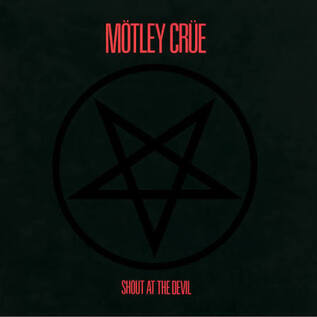
Today we’re trying on an obscene amount of hairspray with Mötley Crüe’s second album: the 1983 release *Shout at the Devil*.
Now, many people may write this off as ’80s hair-band crap. But let’s not throw the baby out with the jacuzzi water.
As a hair-band-crap kid growing up in the ’80s, this wasn’t just an album—it was practically required listening by law. I’ve heard this record probably, quite literally, 500 times.
Today, I’m going to try my best to put on my adult ears and leave the sweet, sweet haze of nostalgia at the door so I can give an honest review of a bunch of guys who had a song called “Dude Looks Like a Lady” written about them.
## In the Beginning
A deep, howling wind opens “In the Beginning” as a choir of demons gives us some theatrical AHHHs and funeral bells chime in the distance. Deep synths provide some low-end dread while album engineer Geoff Workman, who spells his name G-E-O-F-F, just so you know what kind of guy he is.
Anyway, Geoff lends his voice for the narration, credited on the record as “Allister Fiend.” It’s a poem—or a manifesto—written by Sikki Nixx. The Earth is in ruin and evil rises. Now, many, many lifetimes later, when everything is at its absolute worst, it’s time to be strong and shout at the devil!
And as I postulate this prophecy, something in the back of my mind asks: Are we there yet? How much worse can the world get?
I mean, the US voted in a twice-divorced, four-time-bankrupt business owner, failed game-show host, felon for president! Surely these are end times?
Or am I considering the profound words of Likki Tixx a little too deeply?
## Shout at the Devil
The next track is the title track, “Shout at the Devil.”
Heavy Zeppelin-style drums kick down the door with that slick, polished ’80s metal guitar production, and the “SHOUT!” gang chants come roaring in. It’s got that immediate, arena-ready impact that makes you want to smash a mailbox with a baseball bat.
Vince Neil growls, screeches, and howls through some verses about... well, something. To this day, I challenge anyone to transcribe his actual lyrics on these verses without looking at the sleeve; it’s just a series of high-pitched YELPS, grunts, and vowel sounds.
Honestly, mumble rap may have found its secret origin story right here in 1983 Sunset Strip glam metal.
Mick Mars and Tommy Lee are absolute monsters on this track. Every single drum hit, guitar fill, and heavy riff is absolute perfection for the song. Mick’s tone has this razor-sharp bite that punches you right in the teeth, while Tommy’s snare sounds like a dynamite blast of coke off a public bathroom toilet tank.
A “Shout! Shout! Shout!” chorus chant picks up, layering more gang vocals on top of the pile as the song fades out into feedback.
## Looks That Kill
Next up is “Looks That Kill”—more killer work from Mars and Lee.
The drums pound into your chest while the guitars are double-tracked in stereo and smoothed out to total perfection. It builds on a simple, driving pentatonic riff that stays stuck in your head for three weeks straight whether you want it there or not.
The overall feel carries this track completely, riding high on pure swagger and leather-clad momentum.
It really doesn’t matter what Vince is actually saying, because his voice functions more like an extra percussion instrument shouting over the top.
Digging deeper here, Kikki Fixx isn’t a great songwriter. His arrangements are basic, his chord progressions are straight out of Rock 101, and his lyrics read like a notebook from an edgy middle-schooler.
It doesn’t matter what material you throw at them, Tommy and Mick are just talented enough to make anything move—and move you.
The guitar solo here is brilliantly written and executed—melodic, aggressive, and perfectly tailored to the track—right up until Vince comes screeching back into the room to ruin the party.
Seriously, how the hell did Mikki get sole writing credit for all of these songs when the entire weight of the music rests on the drums and guitar tone?
I really do like the gang vocals employed across the album, though. It’s a great sonic theme that glues the whole thing together, making four guys in hairspray sound like a mob of drunk hooligans outside a pub.
## Bastard
Then we hit “Bastard.”
Again, I can practically hear John Bonham pounding out these drum parts from beyond the grave, bringing a raw, heavy-hitting thunder that feels way too big for standard glam rock.
The intro kicks along with a fast, driving tempo, and then suddenly we drop into half-time as Vince whispers:
> “Out go the lights, in goes my knife...”
It’s a sudden shift in gears that gives you a genuine sense of whiplash in the best possible way.
The tempo changes and structural writing here are genuinely smart, and the guitar solo just screams, ripping through the mix with pure, unadulterated distortion.
The whole track has an aggressive, nasty edge.
I love their absolute commitment to material designed specifically to make parents freak out. They knew exactly what they were doing targeting the Satanic Panic mindset of the era.
Combined with the pentagram album cover, during the peak Reagan era, this was pure marketing genius that printed money.
## God Bless the Children of the Beast / Helter Skelter
Side 1 wraps up with “God Bless the Children of the Beast” and their cover of “Helter Skelter.”
Mick gets sole credit for “God Bless the Children of the Beast”—a gorgeous, atmospheric acoustic instrumental carrying that distinct ’80s tone you find in interlude tracks from bands like Metallica, Testament, or Savatage.
It gives the album a brief, haunting moment of breathing room before the chaos starts up again.
It proves once again that Mick is the star, and Tommy is the stardust that made this band what it was. They provide the actual muscle and soul of the group while the other two handle the press photos.
Give them any scrap of material, and they’ll turn it into gold through sheer attitude and technical execution.
As for “Helter Skelter,” an entirely unnecessary cover of the Beatles classic was, ironically, one of the main things that drew me to this band originally.
I knew the Beatles version, but this felt completely different—like it was heavy in the way it was meant to be for an ’80s metal kid looking for maximum noise.
It takes the frantic energy of the original and coats it in hairspray, leather, and cheap distortion.
Listening now, I could still do with literally anyone other than Vince on vocals—maybe a singer who doesn’t sound like he’s passing a kidney stone—but otherwise, it’s a solid attempt for the era.
It’s heavy, and it works remarkably well as a side-one closer.
I particularly love the very end with the drum noise, where you can hear Tommy put down his sticks, stand up, and accidentally bump right into his snare drum.
Beautiful.
Leave it in the mix!
It’s those little unscripted, raw moments that give a record actual personality.
## Red Hot
Side 2 kicks off with “Red Hot.”
Tommy shines brightest here with that thunderous, galloping drum intro we all know, double-bassing his way through the track like a man possessed.
Mick steps in with another legendary riff, cutting through the drum assault with pure muscle.
Then Vince feels the need to count off a song that is already currently playing at 180 beats per minute, which makes zero logical sense.
He’s like a Temu David Lee Roth. All strut, high kicks, and hairspray, but no actual vocal chops or charm to back it up.
The gang vocals carry on here and the formula still works—you can’t help but sing along to the ridiculousness of it all.
I’ll admit, this is my favorite song on the record.
The sheer velocity of it is infectious. The way the drum pattern carries the weight, and those sudden stops with the floor tom roll right before the chorus? Chef’s kiss.
The dual-guitar solo overdubbed by Mick is top-tier ’80s shredding that still holds up today.
“RED HOT!” chants take us to the finish line in a blaze of glory.
## Too Young to Fall in Love
Moving into “Too Young to Fall in Love,” I’m beginning to think those pentagrams and dark imagery were all used in a ritual to resurrect John Bonham just to play drums on this album.
The drum production is just absurdly huge, completely swallowing the bottom end of the track.
The formula, while catchy, starts to wear a little thin around here when listening to the record straight through, as you realize almost every track relies on the exact same structural tricks.
On its own, though, this song is great, catchy, teenage-heartache hard rock that belongs on every ’80s driving playlist.
Tommy and Mick do their absolute best to elevate the vibe, adding subtle guitar fills and syncopated beats to keep things interesting, and they succeed.
You know who they should have kicked out of this band instead of Mick Mars years later?
Vince!
He is by far the weakest link here and on every single project they ever touched.
Oh wait... they did try that in the ’90s!
And they made one of the absolute best hard rock albums of the decade that everyone completely ignored because it didn’t have the famous face on the cover.
Trust me, if you haven’t heard the 1994 Corabi album, you are missing out on a masterclass in heavy, grungy, ’90s hard rock.
It doesn’t sound very Crüe-like, which in that case was an unbelievable improvement in every conceivable metric.
## Knock ’Em Dead, Kid
“Knock ’Em Dead, Kid” brings more pounding Bonham-style drums and a filthy riff from the man from Mars.
The groove is nasty, strutting along with a street-tough attitude that feels like a brawl in an alleyway behind a club.
Again, whatever Vince is screaming doesn’t even matter, because his voice is buried under layers of effects and sheer guitar volume.
It’s the riff and those massive “KNOCK ’EM DEAD!” chorus chants that sell the track to the nosebleed seats in the arena.
You cannot convince me that Mars and Lee didn’t write the vast majority of this music based around their jam sessions in the rehearsal room.
They are so locked in and owning what they’re doing here—like a modern-day Page and Bonham laying down the law.
Or... a 40-years-ago modern version of Page and Bonham.
Look, you get what I mean!
The chemistry between the guitar and drums is the only real substance this band ever possessed.
## Ten Seconds to Love
Next is “Ten Seconds to Love”—sleazy, grinding guitar and more plodding drums that drag along like a hangover.
The production on this entire album is dark, punchy, and a little muddy, which fits the whole aesthetic surprisingly well compared to the ultra-sanitized hair metal that came later in the decade.
Overall, the guitars are cranked to eleven, the bass is buried because Vicki Lixx has no idea how to play a bass, the drums sound like *Physical Graffiti*-era Zeppelin, and the vocals sound like half alley cat and the other three quarters your alcoholic Uncle Jeff.
Your Uncle Jeff with a J, because he’s not a fucking communist!
I should probably say something about the actual song: it’s packed with double entendres about sex that really appealed to a 9-year-old kid in 1983 who thought they were being profoundly rebellious.
## Danger
The album closes with “Danger.”
Neil Peart must have stopped by the studio to fill in for Bonham on this track, because Tommy starts throwing in complex, atmospheric fills that feel way too sophisticated for a Sunset Strip band.
Mick turns in another heavy ’80s masterclass in riffage and feel, letting the chords ring out with a dark, melancholic weight.
Meanwhile, synths sneak into the background in a way that feels a little bizarre for a record that spent nine tracks trying to convince you it was summoning the devil.
This feels like their attempt at writing their own “Dream On”—a grand, dramatic power-ballad finale.
For four young lads with barely a brain cell to share between them, the composition is actually pretty impressive and ends the record on a surprisingly moody note.
Here’s the kicker: this song is credited to everyone except Tommy—and he’s the best damn thing about the track!
The rest of you guys are a bunch of pricks for cutting him out of the writing credits on this song!
Honestly, on every song!
He gets ZERO writing credit for an album that he basically carries on his back from the very first beat of track one!
Mick does his heavy lifting too, but none of these songs would be anywhere close to what they became if Tommy wasn’t behind the kit driving the bus.
I’m writing a strongly worded letter to Dikki Prixx right now to tell him exactly what I think about this injustice!
**AND YOU SHOULD TOO!**
# So, What Did We Learn Today?
*Shout at the Devil* is a total time capsule. A relic of its era, right alongside Cabbage Patch Kids, lawn darts, and *Octopussy*.
It’s really hard to judge this one in a vacuum.
Part of me wants to evaluate it purely on 1983 nostalgic context, and another part of me wants to judge it on overall musical quality compared to other records.
So... I’m going to give this one two separate ratings.
### The 1983 Rating
The first rating considers the era, the attitude, and the sheer marketing genius of the time.
**3.5 Pentagrams out of 5**
### The Modern-Day Rating
However, as a pure musical experience today? This record has not aged particularly well.
Even the strong parts are wildly uneven, and while some nostalgia-heads might say that’s “the charm,” I, on the other hand, say that’s the sign of a mess.
So here is my final, official rating and justification:
**Tommy: 1 bottle of Jack**
**Mick: 2 bottles of Jack**
**Nikki: ZERO bottles of Jack**
**Vince: MINUS 1 bottle of Jack Daniels**
Because his vocals are rough and he’s a drunk-driving, reckless piece of shit.
That leaves us with a grand total of:
# 🍾 2 Bottles of Jack out of 5