
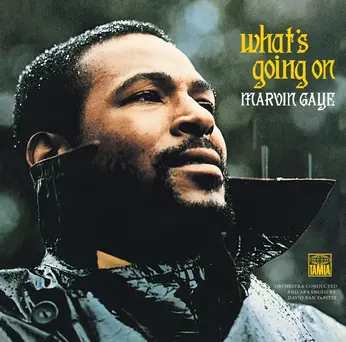
The world was on fire — Vietnam, protests, inequality, cities crumbling, the environment circling the drain. And Marvin Gaye looked at all of that and thought, “Yeah, I need to sing about it!” No dancing in the streets here, no “let’s get it on.” Instead, he made a 35-minute sermon about how everything is broken, and somehow he wrapped it in the smoothest, most beautiful soul grooves you’ve ever heard.
This isn’t a party album. This isn’t even a “throw on while cleaning the house” album, unless you need to mop, that could happen from all the tears this album brings. It’s heavy, it’s beautiful, it’s prophetic. I’d never heard the whole thing through before now, but I have heard most of it playing over the speakers as I’ve shopped at the local adult toy store. Nothing says “sexy fun time” quite like Marvin Gaye singing about war, famine, and drug addiction.
We open on party chatter — clinking glasses, laughter, the sound of people pretending life isn’t collapsing outside their door. And then Marvin strolls in like the smoothest party crasher alive: “Mother, mother, there’s too many of you crying.” Boom. The mood shift is instant. You thought you were at a cookout, but no, you’re in a therapy session with the funkiest background band of all time.
The groove is so mellow. The bass hums along like everything’s fine, the horns sigh like they’re too tired to argue, and Marvin floats over it all with a falsetto so sweet it could trick you into forgetting he’s listing every major crisis of the early 70s. Poverty, war, violence — and just when you start to sink into the hopelessness of it all, here come the finger snaps and his buddies chiming in again, like “No, no, this is still a hangout, we’re all in this together.”
Those Finger snaps and background ad-libs remind us this is still supposed to feel communal. But you can’t ignore that the lyrics are heavy as hell. Marvin croons “What’s going on?” like he genuinely doesn’t know, and here we are fifty years later still shrugging back at him, “No idea, man. Same old shit.”
The music keeps that mid-tempo summer glow — strings floating, percussion steady. But lyrically? It’s basically What’s Going On, Part Two: Electric Boogaloo. He literally repeats the question “What’s going on in this land?” which makes me think they could’ve just tacked this onto track one and called it an extended mix.
Here Marvin’s checking in with his brother, asking how he’s doing, how the world feels. Guess what? Still awful. He sings with this sighing resignation, like he’s already tired of asking but can’t stop. A saxophone pops in to ask, “Things still messed up? Yep, thought so.” I’ll check back later.
The contradiction here is almost cruel: the music sounds warm and inviting, but the words are exhausted. It’s like drinking a piña colada while watching puppies get hit by cars. Refreshing and traumatizing at the same time.
And then the clouds roll in for real. The percussion fades, replaced by dreamy oohs and ahhs that sound like someone already halfway sedated. Marvin steps in to talk about addiction, and he doesn’t sugarcoat it. “I know I’m hooked, my friend.” That’s not poetry — that’s confession.
The production gets muddy, like the whole band is playing from underwater. The drums are distant, the mix foggy, and Marvin sounds like he’s slowly sinking into quicksand. It’s heartbreaking because he’s not raging or pleading — he’s resigned. He knows better, he feels the guilt, but he can’t climb out.
And it just drifts. No big cathartic explosion, no relief. Just the sound of someone admitting their pain at 3 a.m., and then letting the silence swallow it up. Which, to be fair, is about as honest as it gets.
We drift straight out of Flyin’ High into Save the Children, and Marvin decides to stop singing and just… talk at us. It’s not even poetic. It’s literally him saying, “Who’s going to care for the kids when we’ve trashed everything?” And you think, “Oh, cool, more guilt.” He doubles down by then singing the same lines back at himself, like he’s playing both preacher and choir.
Musically, it’s soft and gorgeous — strings, gentle groove, Marvin’s falsetto glowing like candlelight. But lyrically? Heavy as a cinder block. He’s basically saying, “Congratulations, you’ve ruined everything, and your kids are screwed.” And hearing this in 2025, it’s less “warning” and more “yep, nailed it.”
It’s the kind of track that makes you stare out the window and wonder why you pay taxes. And just when you think maybe he’ll lighten up, he pivots straight into…
The first side flows like one long sermon, and when we hit God Is Love, it’s Marvin dropping the shortest, most direct homily of the bunch. Barely two minutes, but it’s packed: drums bounce, piano skips along, and Marvin goes full preacher mode. No metaphors, no detours. Just: love your mother, love your father, love your brother, love your sister, love God. It’s like he’s reading directly from the “Kindergarten Rules for How Not to Be a Jackass” playbook.
On the surface, it’s uplifting. The little gospel lift, the choir feel, Marvin practically glowing. But listen closer, and there’s desperation bleeding through. He’s not just singing it like a fact; he’s pleading like a man who knows nobody’s listening. When he cries out “Have mercy,” it’s less Sunday service and more “hey God, we’re screwing this up real bad, maybe step in any time now.”
Because the album is sequenced like one continuous meditation, God Is Love doesn’t really end. It just dissolves, almost mid-breath, into Mercy Mercy Me. It’s Marvin saying: “If you don’t love one another, fine, then at least love the Earth while it’s still here.”
If there’s one song from this album that still lands like a thunderbolt, it’s this one. The rhythm guitar bounces, the drums shuffle, and Marvin slides in with that sweet, honeyed croon: “Oh, mercy, mercy me…” For a second, you think it’s a love song. Then you realize he’s singing about polluted air, poisoned water, vanishing species, and the planet choking to death. Surprise!
The wild part? This was 1971. He was already singing, “Things ain’t what they used to be.” If Marvin came back today and saw what we’ve done since, he’d probably just shake his head, sigh, and crawl back into his grave.
Musically, it’s gorgeous. The sax solo drips sadness, the ghostly choir sneaks in at the end like a funeral procession, and the whole thing fades out like Earth itself taking its last breath. It’s beautiful. It’s devastating. It’s Marvin Gaye saying, “Hey, I told you so,” five decades before we all started Googling “climate apocalypse.”
Billy Preston-style piano kicks things off before bongos and bass drag us headfirst into an Afro-Cuban street parade. Marvin croons about inequality, but instead of wallowing, he decides to toss out a few kudos: “Hey, you’re helping the sick? RIGHT ON! You’re actually listening to people’s cries? RIGHT ON!” It’s like Oprah giving out cars, only it’s Marvin handing out validation. “You get a validation! You get a validation! Everybody gets a validation!”
Speaking of validation, a couple of days ago, I was having lunch downtown. Nice place, terrible parking. Which, now that I say it out loud, describes about 90% of downtown restaurants everywhere. Anyway, I finish my meal, walk back to my car in the lot down the street, and realize: I forgot to get my parking validated. No big deal. I walk back — easy peasy. (Does anyone even say “easy peasy” anymore? Did people ever say it, or was that just some weird phrase we all agreed to tolerate?) I’m never going to say it again!
Anyway, I get my validation, head back, and guess what? I’m six minutes late. Six. And my car is already up on the tow truck, dangling like a condemned criminal. It cost me $150 to get it down.
Moral of the story? Validation is important. Especially early on.
Oh yeah, the song. At first, the groove is easy — strut around, nod your head, maybe sip something cold. But then you realize the damn thing goes on forever. The Afro-Cuban feel eventually dissolves into Marvin yelling at us again about loving mothers, fathers, brothers, and God, only this time he’s backed by strings and an angry saxophone that sounds like it wants to mug you. Then, out of nowhere, a flute shows up. Was War recording next door?
Eventually, the whole thing explodes into full-on funk chaos. The band pounds on everything in sight like they’re trying to break out of the studio. And then — crash! Pounding piano slams the door shut, leaving you winded and wondering if Marvin just invented three genres in one track. Which, he probably did.
After that roller coaster, Wholy Holy sneaks in like the cool-down room at a sketchy rave. Some mellow strings lullaby us in the background while Kenny G makes a visit to the studio for some radio-friendly faraway sax. Marvin’s not really singing; he’s crooning, gently urging us to just surrender to love, follow the Bible, and everything will be fine. Which, honestly, sounds great, but also a little like “Have you heard the good news?” pamphlet material.
The whole thing has a lullaby quality to it, but it’s also a little preachy. I kept waiting for Marvin to pass around the collection plate. He’s basically saying, “Sure, the world is burning, but if you just love hard enough, it’ll all work out.” I don’t know, Marvin. Logic tells me that maybe recycling and, I don’t know, not funding endless wars might help too.
Still, his voice sells it. Even when he’s basically sermonizing, there’s a fragility there, like he’s trying to convince himself as much as us. It’s beautiful, sure — but also the point where you might find yourself checking how much longer is left on the track.
Anyway, Kenny is still floating around, Marvin is still telling us about salvation, and the strings are making me feel h;lsk;lkfgas;lgk
Shit, I fell asleep there, but luckily the sweet, sweet, afro-cuban vibes on Inner City Blues have brought me back from the brink. The closing track starts with bongos. Because what says “urban decay” more than bongos? The bass joins in, heavy and dark, while Marvin drops the biggest truth bomb of the record: we’ve got money for wars and moon shots, but somehow nobody’s fixing the streets. It’s the kind of lyric that makes you nod, laugh bitterly, and then immediately check your own bank account for confirmation that yes, you too are broke.
The groove itself is hypnotic — percussion circling like a vulture while Marvin hollers from the middle of it all. It’s both protest anthem and dance track, because hey, if the system’s going to crush you, you might as well get a boogie in before it does.
Near the end, Marvin circles back to Mercy Mercy Me theme, tying all the misery together into one neat little bow: poverty, CHECK, pollution, CHECK, addiction, CHECK, violence, CHECK — all connected, all still here. Then, one by one, the instruments drop out until it’s just the bongos, quietly tapping like the sound of the world fading out. By the time they disappear, you’re left staring blankly and thinking, “Well, that sure was depressing.” And Marvin’s ghost just whispers back: “Yeah. That was the point.”
That’s What’s Going On. A heavy, brilliant record that still feels uncomfortably current. If you made it all the way through this episode without curling up into a ball or pouring yourself a stiff drink, congratulations — you’re stronger than me.
This is 1971 history in 35 minutes. Obviously, I’d heard a few of these songs, but hearing this as one message, all together, I realized two things. First, I don’t feel like people make albums this focused any longer. I’m not sure if that's good or bad, because this was a downer from song one due to the topics.
And the second thing is, umm, I don’t remember.
My takeaway? I’m not sure I would ever put this on for enjoyment. This is a class.