
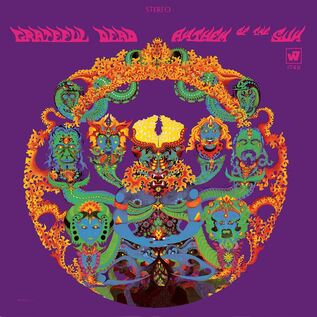
We are diving headfirst into 1968 with Anthem of the Sun by Grateful Dead.
Quick side-note before we begin: if you call them “The Grateful Dead,” you’re ignorant. There is no “The.” It’s just Grateful Dead. Saying "The Grateful Dead" is like saying "The Metallica" or "The Walmart." Stop it. You're embarrassing yourself in front of, well basically nobody, but, oh well, whatever, nevermind. Hmm, that would make a great lyric!
Anyway, Anthem of the Sun is the album where the band decided to take the chaotic, LSD-drenched energy of their live shows and try to mash it onto a flat piece of vinyl for the world to enjoy—or be deeply confused by. They literally took live tapes from dozens of shows, mixed them with studio tracks, and spliced them together like a mad scientist trying to build a monster out of guitar pedals and hallucinogens.
So grab your sandals, light the incense, lock up your prized possessions, and maybe stay away from the bucket of Kool-Aid in the corner as we dip our minds into Anthem of the Sun.
That's It for the Other One
Which is a four-part suite that basically functions as a 7-minute audio trip.
Part 1 is "Cryptical Envelopment"
Some droning Farfisa organ glides in like a haunted church service, accompanied by Jerry Garcia’s heavily processed voice telling us a cheery little story. "The other day they waited, the sky was dark and faded..." Party over, oops, out of time! Sorry, sidetracked by Prince for a second.
Here, the waiting crowd decides that someone has to die. Dark way to start an album, guys! Jerry’s voice gets darker and more processed as we move through the passage. Finally, at the end, as he dies, rainbows explode and the man realizes he had to die. Ah, yes. The classic "I died and turned into a rainbow" trope. Standard Tuesday in San Francisco, 1968.
II. "Quadlibet for Tenderfeet"
We move into the second section, where The Other One rhythm and feel really take shape. By the way, did you know that a quodlibet is a Latin-rooted term meaning "whatever you please"? and It most commonly refers to a musical piece combining different melodies simultaneously. So "Quadlibet for Tenderfeet" loosely translates to: "Play whatever the hell you want for those folks in the crowd with bunions." Very thoughtful of them to cater to the orthopedic demographic.
III. "The Faster We Go, the Rounder We Get"
The music gets tighter as we roll into Part 3. Bob Weir steps up to the mic to sing about the Spanish lady and her rose. This section feels like pure stream-of-consciousness lyrics, ending with the line: "The heat came by and busted me for smiling on a cloudy day." Great poetic stuff, honestly!
You can really hear the extreme youth in Bob’s voice here. Especially on the "comin' around, comin' around" chorus, where his voice cracks like he’s a 14-year-old mid-puberty who just got asked to do public reading in English class.
Then we get some of the most undeniably Grateful Dead lyrics ever written: escaping through lily fields, coming up to an empty space that explodes and leaves a bus stop... a bus stops, he gets on, and cowboy Neal Cassady drives them around Neverland in a full circle. It’s like a Dr. Seuss book if Dr. Seuss was addicted to Benzedrine and drove a school bus like the one from The Muppet Movie. It is THE Muppets by the way, you dumbass!
Next, part IV. "We Leave the Castle"
Jerry gives us a brief "Cryptical Envelopment" Part II—or a reprise—before we plummet into "We Leave the Castle."
This section is a driving, pulsing collage of noise, sound effects, distortion, and "prepared" piano—which in this case, I’m pretty sure just means they shoved a bunch of wooden clothespins and silverware directly into the piano wires while high. Eventually, the whole track melts into a thick molasses of reverb and tape manipulation.
I hear incredible similarities here to what Frank Zappa was doing with We're Only in It for the Money and Lumpy Gravy, which came out just a few months prior. It’s chaotic, it’s avant-garde, and it’s definitely the sound of a studio engineer having a nervous breakdown trying to follow the band's instructions.
New Potato Caboose
Gentle guitar grows right out of the destruction of the last track. Happy, Monkees-style bass, 60s keyboards, and delicate chime sounds lift the mood completely.
Out of context, the intro is surprisingly poppy! That is, until they start singing about the sun coming up blood red, and the whole "church-like, all-graceful-instruments-are-known" section happens to remind you: "Hey man! We're EXPERIMENTING!"
I'm serious, though—with just slightly different production and a haircut, this song could have been handed straight to The Monkees during their brief psychedelic-prog phase. Can you picture it? Micky Dolenz singing about blood-red suns while Jack Nicholson produces it? I'm talking about magic here, people!
Eventually, our "New Potato" rolls into some very familiar, home-cooked Dead territory. Feedback creeps in, accompanied by a heavy, moody organ that sounds like Ray Manzarek got lost on his way to a Doors rehearsal.
The extended jam section in the second half of this song is where the album really stakes its claim. They capture this loose, pulsing, floating beauty. Jerry’s guitar is completely free-form, soaring right over Mickey Hart and Bill Kreutzmann’s locked-yet-loose dual-drum rhythms, while Phil Lesh’s bass line dances all over the fretboard. It’s a massive step forward in ambition compared to their self-titled debut.
Born Cross-Eyed
"Born Cross-Eyed" kicks in and immediately feels like it’s just the next logical movement of "New Potato Caboose." There are a lot of wild time signatures and shifting rhythmic feels packed into this record.
When Bob sings "Think I'll come back here again," immediately followed by a wall of blaring brass horns, it’s a killer production choice.
This entire album isn't structured like a collection of singles; it’s a continuous mood—a specific, swirling energy they were chasing in the studio. The production keeps the sonic textures of the instruments remarkably consistent from track to track, allowing each song to segue seamlessly into the next.
Side 1 ends on a sudden hit and slow fade of distorted guitar and crashing cymbals. I have to hand it to them—I really like the production here. It’s dark, dense, and wonderfully mushy. It feels a bit like Sly and the Family Stone's There's a Riot Goin' On, just with significantly more acid and a lot less angel dust.
Alligator
Side 2 kicks off with a drum beat that is practically begging to be sampled by a 90s hip-hop producer. Seriously, someone call Q-Tip, Yasiin Bey, or Pharrell immediately! I would love to hear the opening drum break of "Alligator" blasting on the radio today.
The rest of the band jumps in with a long, looping guitar line and... kazoos. Yes, kazoos. Because nothing says "fine musical craftsmanship" quite like a plastic party favor from your child’s friends birthday party at McDonalds in 1968. With the little metal ashtrays and the completely germ free outdoor play ground where they kick the homeless out of at 5:30am right before they open. Here’s a cup of coffee, you can have it and move on or I throw it on you! No? Maybe that was just the way my mom managed our local McDonalds. Anyway.
Pigpen steps up to the microphone, singing about a creepy alligator that feels like a very thinly veiled metaphor for some sketchy characters in his personal life. Meanwhile, the rest of the band hums, howls, and groans in the background. The backing vocals sound so detached and bizarre that they almost feel like they were recorded for a completely different song and accidentally spliced in by a sleepy tape editor—yet, through the sheer magic of LSD, it somehow works!
Eventually, we arrive at the mandatory "freak-out" section. Mickey and Billy let loose on a mesmerizing, polyrhythmic drum journey while Bob Weir casually encourages the crowd: "Get up and dance, it won't ruin ya!" (Debatable, Bob, but thanks for the encouragement.)
Jerry and Bob start talking back and forth about this alligator that keeps lurking around their door—their cabin door! Bob gives us a little Robert Plant cosplay on the vocals before Jerry cranks his guitar up to 11 and the rest of the band follows him right off the cliff.
Everything gets turned to maximum volume as they fade in and out of time and space. This is the musical equivalent of an 18-wheeler truck being launched through a wormhole in outer space.
As that famous author George W. Bush once said: "Let's not put all our eggs in one sock." And that is exactly what's happening here. The Dead spread their wild, improvisational live jamming across this entire album to create something incredible. It wasn't just groundbreaking for 1968—it has aged remarkably well as a standalone piece of avant-garde rock art.
Caution (Do Not Stop on the Tracks)
The feeling of one continuous, unbroken piece of music carries directly into "Caution." The driving drums keep pounding as Pigpen takes over to tell us a story about visiting a gypsy woman for some desperate relationship advice.
The gypsy looks at him and tells him: "All you need, all you need, all you need, all you need, all you need is just a..."
Hold on a second. Did the gypsy actually say "all you need" that many times in a row? If I went to a fortune teller and she started repeating "all you need" fifteen times like a scratched CD, I wouldn't think I was getting spiritual enlightenment—I’d think she was having a stroke! I might have called 911 right then and there.
Anyway, after her neurological glitch passes, she finally tells him he needs a "touch of mojo hand." And judging by Pigpen's delivery, a mojo hand feels pretty damn good.
By the way, did you know that a mojo hand is a traditional magical amulet, lucky charm, or spell bag enclosed in cloth, deeply rooted in Hoodoo traditions? Well, I didn't! Look at us, learning culture while listening to 60s hippies scream about alligators!
"Caution" eventually morphs into a full-blown, psychedelic, throbbing smorgasbord of soaring guitar feedback and pounding drums. It climbs and climbs until it finally collapses into a glorious ocean of noise, static, and feedback, slowly fading out to close the album.
The Wrap-Up
Anthem of the Sun is a wild ride. It’s dense, a little dark, and deeply experimental. The sound is incredibly cohesive—it delivers the feeling of one singular, continuous artistic suite rather than just a collection of radio-friendly singles jammed onto two sides of vinyl.
It contains some of the best, most intentional uses of studio feedback and tape noise I’ve ever heard. Every jam, every noise fest, and every polyrhythm felt purposeful. This was the sound of a young band that was hungry to invent a new musical language and show the world that their live magic could exist on record.
So, where does it land on the official scale?
I give Anthem of the Sun 5 sugar cubes out of 5. This is genuinely great, uncompromising art.