
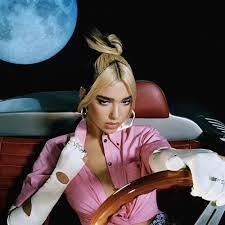
Dua Lipa’s Future Nostalgia — the title alone feels like a dare. Like, “I’m going to make an album that sounds like you’ve already heard it, but with shinier buttons and a compression setting that could flatten a fucking mountain.” It’s disco, it’s EDM, it’s pop, so polished you could see your reflection in it, and it’s got enough writers per track to field a football team.
The question isn’t whether it’s catchy — it is. The question is whether it’s anything else. So let’s dive in, track by track, and find out if Future Nostalgia is the sound of tomorrow, or just the sound of Pro Tools gasping under the weight of all those plug-ins.
The album opens with minimal production and Dua talking at us in her British accent like she’s a dance-floor tour guide. Then the beat drops, and suddenly every compression plugin in existence has been duct-taped together and slammed into the red. If someone had asked me in 1994 what music in 2025 would sound like, I might have described exactly this: dry, clinical, and somehow still danceable.
The lyrics? Fluff city. But then that refrain hits — “I know you ain’t used to a female alpha” — and I can’t lie, it works. It’s cocky in the right way, like she’s smirking while daring you to keep up. By the time the funk breakdown slides in — complete with chicken-scratch guitar and Minneapolis-style synth stabs — I’m waiting for Morris Day to strut into the studio just to class things up a notch, Jerome just behind him with a mirror in hand.
The last third of the track mashes everything together: disco stomp, funk bounce, modern pop shine. It’s not a revelation, but it’s a solid opening flex. She’s planting a flag that says, “This is a disco album, and if you don’t like it, there’s the door.”
This is where things really click. A little piano, some reverb, and then one of the most infectious disco basslines of the past decade struts in like it owns the place. Chic could’ve written this in 1978, and Nile Rodgers probably hears it in his sleep. It’s disco reborn, rebuilt for 4k, and slick enough to soundtrack every commercial break during the Super Bowl.
It’s disco through and through, but it doesn’t feel like cosplay — it feels like Dua’s team actually respects the source material. If Future Nostalgia is about reimagining the past, this is the track where it actually clicks. The compression is still fatiguing, but if you close your eyes and focus on that bass, it almost doesn’t matter who’s singing. Dua, Kylie, Kylie Jenner — hell, even Yoko Ono. Actually, scratch that. If Yoko sang this, it might become my favorite track of all time just for the chaos of it.
The chorus punches just hard enough to get stuck in your head, and the verses keep the momentum. This is what “future disco” should feel like: familiar, but a little shinier than memory allows.
The album downshifts into synthpop territory, opening with what sounds like a Casio preset called Sexy ‘80s Commercial. The vibe is breezy, neon, and nostalgic in all the obvious ways. Dua leans into it, delivering her lines with detached cool that matches the title a little too literally.
Here’s the issue: with three producers and seven writers credited, you’d expect something memorable. Instead, we get “got me losing all my cool” on repeat until you wonder if that’s literally all they wrote before enjoying some videos on TikTok. The production is crisp — you can practically hear each synth line sparkle — but the words feel like placeholder text they forgot to replace.
That said, the track is undeniably catchy in a disposable way. It’s not art, it’s not profound, but if you put this on during a road trip, you’d probably hum along without realizing it. Cool is perfectly named — sleek, shiny, and ice cold. Unfortunately, it’s also a little hollow, like an expensive cocktail that looks amazing but tastes like watered-down sugar.
No, it’s not the Olivia Newton-John hit, though for a moment I kind of wish it was. Instead, we get Dua Lipa’s neon-soaked attempt at an ‘80s workout anthem. The synths stab, the drums pound, and the chorus practically screams at you to MOVE. This is Dua’s “pump iron until your eyes bleed” track.
It’s effective, but also exhausting. The compression is so heavy that listening through headphones feels like being hugged by a robot with anger issues. The chorus works, but the verses are forgettable — it’s as if the song only exists for its hook. And while Dua delivers it with conviction, there’s a thin line between commanding and yelling, and she teeters right on it.
Still, it’s fun. Throw it on a gym playlist and you’ll run an extra mile just to escape it. As a dance track, it does its job. As a song, it feels like a copy of a copy — Olivia Newton-John’s title filtered through Gwen Stefani cosplay, then AutoTuned until it barely resembles anything human.
This one kicks off with a little space-age wah-wah sound effect, like when I did too much nitrous at the Phish concert last summer. Then the disco beat drops, and we’re right back in familiar territory — Chic basslines, robotic drums, walls of shiny synths.
The problem is that by this point, the formula is showing. Future Nostalgia is starting to feel less like an album and more like a Spotify playlist built by an algorithm trained exclusively on Katy Perry and Donna Summer. The melodies are fun, sure, and Dua’s confidence sells the “you ain’t built for this” refrain, but the déjà vu is real.
To be fair, the groove is strong enough that it doesn’t collapse under its own repetition. It’s danceable, it’s polished, and it feels like a hit — even if it’s the kind of hit that vanishes from your brain five minutes after the song ends.
Finally, a change of pace. Rubber-band bass and finger snaps start us off, and suddenly the production feels lighter, airier, less suffocating. The arrangement is smart here — percussion and little electronic flourishes fill out the sound without overwhelming it. For once, the mix actually breathes.
Lyrically, it’s thin: “Pretty please, put your hands on me.” That’s basically it, just said in different ways. But simplicity works in this case. Instead of drowning in production tricks, the song lets its groove do the talking. The breakdowns give it texture, and Dua’s delivery sells the playful desperation in just the right way.
It’s not groundbreaking, but it feels distinct on an album that often blurs together. You can imagine this one sneaking onto a '70s playlist and fitting in without much embarrassment. In other words: finally, something memorable.
And just like that, we’re back in EDM cliché land. Four-on-the-floor beat, throbbing synth bass, vocals stretched wider than an Instagram filter. It’s festival music 101: bass drops, muted breakdowns, euphoric builds. You’ve heard this before, probably in 2010 when Lady Gaga was still writing Poker Face clones.
The song is competent — slick production, punchy energy, undeniable catchiness. But it’s also generic to the point of invisibility. If you told me this was a Gaga B-side, I’d believe you. Hell, if you told me it was literally Poker Face 2.0, I’d nod and move on.
The frustrating part is that Dua has the charisma to make it more than that, but the production buries her. It’s not a Dua Lipa song so much as a genre exercise in “how to build a festival banger.” Good for dancing, forgettable for everything else.
Soft synth strings open this one, and for a moment, it feels like a lullaby. Then boom — Bee Gees strings, full-on Saturday Night Fever cosplay. It’s disco déjà vu all over again, with the same verse/chorus dynamics we’ve already heard on half the album.
That said, the strings give it flavor, and the chorus is so forceful it dares you not to move. This is what the whole record is: verses you can casually sway to, choruses that shove you onto the dance floor whether you like it or not. It’s fun, it’s predictable, and it’s relentless.
I can sum up this whole album pretty easily: imagine you’re at a giant bonfire. You’re enjoying a nice cold Schlitz and some pork rinds. Into the fire, you toss in a copy of the Saturday Night Fever soundtrack. And then you toss in a copy of Lady Gaga’s The Fame. Let it burn and then come back a week later when the smoke clears and the heat dies down, dig through the ashes, pull out whatever’s left, and drop it on your turntable. That’s Future Nostalgia.
The opening riff is basically Another One Bites the Dust on layaway, followed by disco hi-hats and another round of déjà vu. At this point, the album is starting to sound like one long track with different choruses stapled on.
The lyrics don’t help — they slide right past without leaving a trace. With seven writers credited, you’d expect at least one memorable line, but nope. Just vague longings wrapped in slick compression. By the end, I couldn’t tell you what this song was about if my life depended on it.
It’s catchy, polished, and disposable. A perfect example of the album’s strengths and weaknesses in one neat three-minute package.
Nine writers. Nine! That should be enough to craft a pop opera, or at least something more ambitious than a cheeky piano loop with rubbery bass. But here we are.
Still, this one stands out because it’s playful. The chorus has a quirky rhythm, is very catchy, and the production feels looser than the rest of the album. It’s not as tightly controlled, and that makes it memorable. For once, you get the sense that Dua is having fun instead of just standing on a conveyor belt of disco beats. A programmed, almost Questlove, kind of beat sounds pretty good against this repeated barroom piano loop that happens in different spots throughout the song.
Is it amazing? No. But after eight tracks of déjà vu, a little personality goes a long way. Good In Bed earns points for being different, even if it took nine people to figure out how to do it.
The closer finally changes gears. String quartets pluck in the background, swelling into a cinematic arrangement that feels heavier than anything else on the record. And lyrically, Dua actually has something to say here.
She digs into how women navigate daily safety concerns — walking home, being harassed, coping with fear in subtle, constant ways. It’s direct, it’s pointed, and it feels genuinely important in a way the rest of the album doesn’t. After so much fluff, it’s almost startling to hear something real.
Is it perfect? Not quite. It leans a little preachy, but honestly, after ten tracks of disco escapism, I’ll take preachy. At least it leaves you with something to chew on besides basslines.
So here’s the deal: Future Nostalgia is sleek, shiny, and well-crafted, but it’s also repetitive and over-compressed. It’s disco for the Instagram generation — fun, polished, and a little soulless. Dua Lipa can sell it, but the real stars are the 24 different producers and their laptops.
That said, when it works — “Don’t Start Now,” “Pretty Please,” maybe “Good In Bed” — it works. The grooves are undeniable, the hooks are sticky, and the production is clean enough to eat off of. It’s a good dance record, maybe even a great one, but it’s not reinventing the wheel.
In the end, Future Nostalgia lives up to its name. It’s a mirror ball covered in fingerprints: familiar, fun, a little funky, and destined to soundtrack your night out whether you like it or not.