
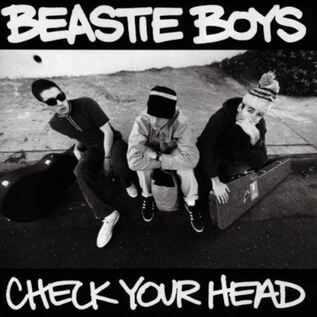
Check Your Head is what happens when three dudes who already rewired hip-hop decide they’d rather jam with their own brains for a while. This 1992 masterpiece was the sound of the Beastie Boys dragging their crates of vinyl, instruments, and egos into a sweaty garage and saying, “Let’s make noise that feels like it smells.
It’s grimy, funky, philosophical, and somehow spiritual — like a funk monk retreat. Gone are the polished samples of Paul’s Boutique; this time it’s live drums, fuzz bass, busted organs, and turntables used more like percussion instruments than tools. It’s a record that sounds alive — like it could stand up and start arguing with you about the best Curtis Mayfield B-side.
Check Your Head isn’t just an album — it’s an environment. A sonic Brooklyn warehouse filled with reverb, incense, and a questionable amount of weed smoke. The boys weren’t just checking their heads. They were politely asking you to check yours, too.
Jimmy James
The first sound you hear? Crowd noise. And not the triumphant “we just headlined Madison Square Garden” kind — more like someone testing the mic at a high school gym. Then that voice: “This is the first song on our new album.” Thank you, anonymous hype man, I was worried I’d accidentally skipped to side B. It’s the first joke on a record that’s somehow both hilarious and profound.
Then that groove kicks in — this isn’t just a beat, it’s a gravitational field. A swampy, swaggering pulse that feels like the turntable itself is half asleep but still cooler than you. Every snare hit sounds like it’s been aged in oak. You can feel the boys settling in: “People, how you doing, it’s a new day dawnin’.” Damn right it is. After Paul’s Boutique’s sample-heavy kaleidoscope, this opener says, “We’re growing up, but we’re not cleaning up.”
It’s the perfect mission statement — loose, funky, and filthy in the best way. Everything’s slightly off-kilter but perfectly intentional. The scratches slice through like broken glass, and every sound seems to argue politely with the next one until they find harmony. It’s chaos theory in rhythm form.
And the samples — oh, the samples. Picking them out is like Beastie Boys trivia night for music nerds. You catch one here, miss three there, then five years later hear some obscure funk track and go, “Wait, THAT’S where that came from!” It’s archaeology for people who dig with their ears.
Funky Boss
“Funky Boss” starts like a mid-70s hangout jam that accidentally got recorded through a lava lamp. Bongos bubbling, live drums snapping, a slinky guitar riff sliding into the mix — then that low-end bass just oozes in like it’s got unfinished business. And then the chant: “Funky boss, get off my back.” It’s simple, but man does it land. It’s the universal worker’s anthem, disguised as a funk workout.
It’s not deep — it doesn’t need to be. This is catharsis in groove form. Every repetition feels like another timecard punched, another useless meeting survived. You can almost hear the smirk in their delivery. It’s the Beasties as your overworked coworkers, still making art in between bouts of eye-rolling. Are they complaining? Sure. But it’s funky. Funky enough to justify the gripe.
Halfway through, the track starts dissolving into a haze of reggae snippets and half-remembered samples, like someone left the radio on while switching channels mid-jam. The structure collapses — gloriously — into a messy, beautiful noise bath.
By the end, it doesn’t matter who the “funky boss” is — record exec, touring manager, metaphorical demon — because the message lands: don’t let anyone mess with your groove. It’s a protest song you can dance to.
Pass the Mic
If Jimmy James was the warm-up, Pass the Mic is when the Beasties throw the gloves off and remind everyone that even though they’ve gone live-band, they can still out-rap your favorite MC. The beat is monstrous — low-end like a subway tunnel at rush hour, with a groove that just keeps mutating every time you start to catch it.
This is one of those “everybody gets a verse” tracks, but it doesn’t feel like they’re taking turns so much as sharing the same brain. You can tell these three have known each other a very long time. They finish each other’s rhymes, cut each other off, hype each other up — it’s like a jazz trio that just happens to yell about white castle and enlightenment.
The production is fat, but weirdly clean. It’s funky, heavy, and constantly shifting. Every four bars there’s a new sound sneaking in — a reverse cymbal here, a synth burp there, maybe a random sample of someone losing their mind in a basement. It’s chaos that somehow lands perfectly on the one.
When this came out, the beasties showed they were building something bigger and stranger — prog rap, maybe. And it still holds up because nobody else ever figured out how to do it like this.
Gratitude
And now — the Beasties plug in, turn up, and blow the doors off the studio. Gratitude is pure fuzzed-out rock & roll swagger, played with the confidence of three guys who just realized no one can tell them what to do or what genre they’re supposed to be in. That bass tone alone sounds like it could knock over an oak tree.
The guitar riff — that wah-drenched, singable little hook — feels like the Beasties tipping their hats to every garage band they ever moshed to, but then they drag it straight through a bucket of bong water and feedback. It’s filthy in the best way.
And when that organ solo shows up out of nowhere? Forget it. It’s like an organ player just kicked in the door, demanded a solo, and left the building smoking. You can practically hear the band looking at each other like, “Was that supposed to happen?” before everything collapses in glorious noise.
This is the track where you realize: these guys aren’t dabbling. They mean it. Punk, funk, rap, rock — it’s all fair game. Gratitude is messy and loud and spiritual and dumb in the most sacred way possible. It’s freedom with a fuzz pedal.
Lighten Up
After all that chaos, Lighten Up floats in and if you turn head just right, toward Brooklyn, you can still sometimes smell the incense they burned during the recording of this song . Bongos, shakers, some laid-back percussion that feels like it was sampled from a Santana soundcheck. Then the organ comes in again — because apparently the Beastie Boys decided this album needed a resident church keyboardist — and suddenly everything is mellow and sunlit.
This is the Beasties’ “deep breath” track. The groove is loose, maybe even improvised, and you get the sense the tape was rolling before they actually decided what to play. There’s even a section that sounds like someone rubbing a balloon on the mic — that perfect “what if?” energy that makes this album feel human and unpredictable.
They keep telling us to “lighten up and shine like the sun,” which, let’s be honest, might be the least Beastie Boys lyric imaginable — but it works. You believe them. They’re finding peace inside the chaos, or maybe just killing time before the next blast of fuzz and feedback.
It all dissolves back into bongos and whispers, and you can almost see the smoke clearing in the studio. It’s not flashy, but it’s essential — the exhale between two wild swings of the bat.
Finger Lickin’ Good
You know that thing the Beasties do where they sound like they’re just fucking around and jamming but it still hits harder than most people’s entire discography? That’s Finger Lickin’ Good. It opens with James Brown drums that instantly demand respect — the kind of groove that makes your shoulders move before your brain can object.
Then that chant drops: “Finger lickin’ good, y’all.” It’s ridiculous. It’s addictive. It’s also the kind of refrain that makes you wonder if they had to pay royalties to Colonel Sanders. (And what the fuck is up with the word Colonial? — why is it Colonial without an R? “Colonial”? Who let that happen? It’s language fraud.
Where is the R? I’m not sure what the word is for people who get hung up on things like this, but I’m one of those people. But, I just think it's bullshit. Like Brett Favre, dude you can pronounce it however you want. But if the R comes after the V, i’m going to say FAVRAY, or Faverr or whatever. Okay, Wait wait wait, I’m being one of those people. I’m listening to the Beastie Boys. They are some enlightened gentlemen. I should accept him. Adam would accept him. If he identifies as a Farve, I should respect that.
There isn’t much lyrical depth here — it’s more about vibe. They sound like they’re hyped up on caffeine and convenience store ephedrine, building a song from pure enthusiasm. The samples are everywhere — guitar stabs, vocal snippets, stray horns — like a Jackson Pollock painting in stereo.
And then there’s the Dylan drop — “Just Like Tom Thumb’s Blues.” It comes out of nowhere and yet makes perfect sense. Because of course the Beasties would pull Bob Dylan into a song about fried chicken philosophy. That’s their genius: absurdity that grooves.
So What’Cha Want
This one hits like a sledgehammer made of organ keys. From the first distorted drum hit, you know you’re in for something grimy and iconic. That pulsing Hammond organ line? It’s practically the fourth Beastie — haunting the track like a funky ghost that refuses to leave until you hit replay.
This was the single — the MTV anthem — and for good reason. The hook is stupid catchy, the verses are aggressive but playful, and the whole track feels like it was recorded inside a lava lamp. “You can’t front on that.” No, you really can’t.
What’s wild is how alive it sounds. The drums breathe. The bass grumbles. The vocals sound like they’re coming from the world’s most confident basement. They blur the line between live performance and hip-hop production until you can’t tell where one ends and the other starts.
When that organ riff circles back in at the end — looping and warbling like it’s about to catch fire — it’s the perfect closer. You could isolate that one piece of the song, play it for someone, and they’d go, “Oh yeah, that’s So What’Cha Want.” That’s how iconic this one is.
The Biz vs. The Nuge
A curveball, even by Check Your Head standards. Suddenly Biz Markie pops up, rapping over what sounds like a late-’70s TV theme being fed through a broken cassette deck. “The Beastie Boys are coming home!” he says, which is equal parts hype man and prophecy.
And then — oh god — Ted Nugent. Well, thats why they call it Biz vs the Nuge I guess. There’s a sample from his track Home Bound, which technically makes him a co-writer here. That’s one of those music industry ironies that feels cosmically unfair, like a universe where Ted gets paid for this. I actually tried to listen to the original Nugent track while reviewing this just to see what the original sounded like. Couldn’t do it. I’d rather handwash dishes at a truck stop than give the Nuge any royalties.
This track is so strange it’s kind of genius. It’s less a song and more a skit with rhythm — like the Beasties testing out what happens when two completely different worlds collide: goofy, lovable Biz and a right-wing guitar gremlin.
It’s quick, silly, and over before you can process it. But it’s also another reminder that Check Your Head was made by a band allergic to doing anything normal. They didn’t care if you “got it.” They were too busy having fun making it.
Time for Livin’
Leave it to the Beastie Boys to cover Sly and the Family Stone and somehow make it sound like a basement hardcore show in 1982. “Time for Livin’” comes barreling in with punk guitars that hit like someone just kicked the door in with a pair of Doc Martens. It’s raw, messy, and loud enough to wake your neighbors — which, let’s be honest, is the point.
If you know the original Sly version, it’s all groove and sunshine and subtle funk rebellion. The Beasties took that, stripped it for parts, and rebuilt it as a punk grenade. There’s no trace of Sly’s mellow groove — this is pure chaos energy. But it still carries the same urgency: Get it together, people. Stop wasting your life. Only here it sounds like it’s being shouted through a megaphone in a skate park.
The best part? They don’t wink at it. They mean it. The Beasties might’ve started as bratty goofballs, but by this album, you can tell they’re not just joking anymore — they’re feeling something. The cover isn’t ironic; it’s reverent, in their own noisy way. And somehow, that reverence comes through louder than the distortion.
It’s one of those “short but feral” tracks that reminds you how much the Beasties loved punk — not as nostalgia, but as DNA. They were always punk, even when they were sampling flutes.
Something’s Got to Give
And then — plot twist — they slow everything down to a crawl. “Something’s Got to Give” sounds like it’s playing from a melted cassette on a hot day, in the best possible way. The bass slides in like liquid, the drums feel half-asleep, and the whole track drips with reverb so thick it could double as incense.
This is mood music — if your mood is “lying on the floor, contemplating existence, wearing thrift-store headphones.” The vocals come in distant and drenched, like they’re whispering from inside you. “I’ve seen better days than this one…” Yeah, same. But the groove keeps rolling, hypnotic and patient.
It’s one of those tracks where you can almost see them in the studio — just vibing, letting the tape run, throwing random sounds into the air to see what sticks. You get watery guitar lines, bits of synth that sound like whale calls, and a groove so slinky it could sneak into a Parliament album unnoticed.
By the end, it’s less a song and more a fog you’ve wandered into. You don’t dance to it. You sink into it. It’s the sound of a band so confident they don’t even care if you’re paying attention — they’re making this one for themselves.
The Blue Nun
And now for something completely weird. “The Blue Nun” is part cocktail lounge, part fever dream. It starts with this spoken-word bit — “The candlelight was just right. The hi-fi was in the background. The wine was delicious.” It’s absurd, and it’s perfect.
The track feels like walking into a hip 1960s dinner party hosted by the Beastie Boys, where everyone’s wearing smoking jackets and quoting Sun Ra. It’s jazzy, loungy, and strangely sensual for an album that also has songs about punching bosses. There’s barely any music — just snippets and atmosphere — but it’s so specific it burns into your brain.
The Beasties were always good at these palate cleansers: the short, surreal interludes that make you go, “What the hell was that?” and then immediately hit replay. “The Blue Nun” is exactly that kind of break — it’s the sound of the band letting the air out of the room before the next explosion.
It’s also the point where you realize how deep Check Your Head really goes. This isn’t just a hip-hop record. It’s a world — chaotic, hilarious, self-aware, and somehow still groovy enough to make sense. And yes, Peter … the wine was delicious.
Stand Together
“Stand Together” sounds like what would happen if a motivational speaker got hold of a distortion pedal and a broken wah-wah. The message is wholesome — unity, empathy, all that jazz — but the delivery is a righteous mess of beats, guitars, and sudden bursts of chaos that make it feel like a pep rally inside a junkyard. The groove keeps tripping over itself, picking up steam, and somehow landing right on its feet.
This track is proof that the Beasties could preach without getting preachy. They’re not wagging fingers; they’re waving arms, yelling “we’re all in this together” from the top of a half-pipe. There’s a sincerity buried in the noise — a reminder that beneath all the sarcasm and sampling, these guys actually cared.
And yet, it’s still fun. It’s still grimy. It’s still got that Beastie sneer tucked between the beats. If every self-help seminar sounded like this, there would be a lot more healthy people in the world.
Pow
The title’s not just clever — it’s the entire listening experience. “Pow” doesn’t start; it erupts. That jagged guitar rhythm is like a paintball to the soul. The rhythm section doesn’t walk into the room — it crashes like Vince Neal on a liquor store run. Before the dust even settles. You’re left blinking, grinning, and trying to remember what just hit you.
It’s part cartoon soundtrack, part acid jazz fever dream. Every sound feels like it’s bee n run through a comic book filter — punchy, colorful, and just slightly unhinged. The band doesn’t play with funk; they ambush it in an alley, steal its shoes, and run off giggling.
By the time the horns fade, your brain feels like a pinball machine that just tilted from joy overload. It’s not a song — it’s a Saturday morning in sonic form.
The Maestro
Mike D steps up to the podium, but don’t expect Bach — expect breakbeats and bravado. “The Maestro” is the Beasties’ idea of conducting: three dudes in matching Adidas suits, waving spray cans instead of batons, commanding an orchestra made entirely of samples, snare cracks, and attitude.
This track swings. It’s swagger with rhythm, style with mischief. Mike D’s delivery feels like a smirk in motion — he’s rapping like he just stole his own beat and can’t stop laughing about it. Every bar sounds like a victory lap.
And yet, buried in the chaos, there’s control. The precision behind the madness. The way the bass locks in with the beat, the scratches dart in like punctuation marks — it’s musical mayhem, but it’s mayhem with a plan. By the end, you’re not just hearing The Maestro; you believe he’s earned the title.
Groove Holmes
“Groove Holmes” and the The organ is still hanging with us. It slides in smooth as butter on hot vinyl — greasy, confident, and with just enough dirt on it to feel lived-in. This is the Beasties’ version of jazz: sweaty basement club energy with bass players elbow knocking into the hi-hat every eight bars.
Named after the late, great organist Richard “Groove” Holmes, the track’s a love letter disguised as a jam session. No rapping, no bragging, just groove — pure and uncut. It’s as if the band collectively said, “What if we just vibed?”
This is where their crate-digger instincts really shine. They don’t imitate the past; they exhume it, polish it, and toss it into the 90s blender until it sounds like jazz for skateboarders. It’s dusty, it’s soulful, it’s stoned on rhythm. “Groove Holmes” doesn’t shout. It glides.
After really digging into this song, this is kind of that ’90s kind of jam band sound. This is something that would fit comfortably on Phish's Story of the Ghost album.
Live at P.J.’s
Now this one — this is chaos on tape. “Live at P.J.’s” feels like a night that started with a local band and ended with the cops showing up. The track oozes that sticky-floor energy: crowd noise, echoing mics, the unmistakable sound of three guys having too much fun to care about mic placement. You can practically smell the beer-soaked carpet through your speakers.
There’s something beautiful about how alive it sounds. Every yell and offbeat crash is a reminder that this band wasn’t trying to capture perfection — they were bottling personality. It’s hip-hop in its pajamas, but still ready to throw down.
Midway through, when the groove tightens and the samples start ricocheting, you realize: this isn’t live at any P.J.’s. It’s live inside their collective imagination — a dive bar built entirely from basslines and bad decisions. The audience might be imaginary, but the energy is all real.
Mark On The Bus
And then Theres whatever Mark on the Bus is. A blues recorded on a tour bus somewhere on a small boombox I assume. “Wont you take me away and take away me.” Its a decent start to a tune that ends in a sort of Zappa madness frenzy. I would have loved to have heard this fleshed out into a full production and not just a bus jam. I feel like this really holds more sentimental value for the people involved and not so much for the listener. Perhaps this could have been cut. So far, not too many down points in the album, this and The Biz Vs. The Nuge. not bad, not bad.
Professor Booty
“Professor Booty” kicks off with a sly sample from Connie’s Store, instantly planting you in some weird, graffiti-sprayed street corner where everyone knows the rhyme but nobody remembers the exact words. There’s a James Brown drum groove under it all, heavy and taut like a string ready to snap, carrying the Beasties’ playful boasting effortlessly.
The vocals are dry, almost academic, but the energy is anything but. They’re dissecting ego and bravado while simultaneously being the embodiment of it. You hear snippets of bass, guitar flourishes, and those signature layers of hooks and samples weaving together like a sonic quilt stitched by caffeinated cats.
It’s funny, it’s sly, it’s relentless — the kind of track that rewards repeated listening. I can ride around on my low-rider bicycle, imagining each lyric bouncing off the curb while the city hums along. And those Hendrix breaths in the background? Absolute icing. The ending drum beat hits like a mic-drop you didn’t see coming, the kind that makes you rewind immediately.
This song proves the Beasties weren’t just making noise; they were constructing an experience. A playful, meticulous, chaotic experience that somehow feels loose and live. And you can tell they’re having fun with it — a band confident enough to let the music do the talking while their personalities peek through every crack.
In 3’s
“In 3’s” is another groove-laden, almost meditative jam. Guitar, bass, drums — they’re all conversing like three friends in a basement late at night, riffing and laughing while the organ takes center stage, later replaced by a Stevie Wonder-style clavinet.
There’s a hypnotic quality here. The rhythms roll like a lazy river of funk, occasionally interrupted by bursts of inventive sample-work and subtle scratches. You feel the album breathing: part jam session, part calculated chaos. These guys understood that repetition could be hypnotic, and they wield it like a sculptor shaping grooves instead of clay.
What’s amazing is that despite all the grooves, the track never overstays its welcome. It’s long enough to establish a mood, short enough to keep your attention sharp. This is the side of Beastie Boys that makes you marvel: a band capable of frantic beats and controlled jams, both executed with equal skill and irreverent joy.
The more you listen, the more you notice the tiny details — the interjections, the unexpected horn, the bass slide just out of place enough to make you smile. It’s the kind of song that’s deceptively simple on the surface but infinitely complex underneath.
Namasté
And finally, “Namasté” closes the album like the sun slipping behind city rooftops. It’s mellow, hazy, and meditative, like the foggy aftermath of a long, chaotic day. There’s a subtle poetry over the groove, and you can almost picture the band reclining on couches, sharing ideas and improvisations while letting the track breathe.
The instruments drift lazily: bass, percussion, some moody keyboard washes. It feels like a reward for making it through the frenetic highs of the album, a chance to exhale while still floating in that unique Beasties universe. It’s the sound of three guys reflecting on their own genius with humor and humility, all at once.
Unlike the other grooves, this one has a spacey, cinematic quality, bridging late-70s funk, jazzy textures, and a 90s underground vibe. It’s not about hooks or punchlines; it’s about presence and letting music do its thing. In a way, “Namasté” reminds you that Check Your Head is as much about letting the band breathe as it is about making you move.
The track fades, and you realize the album has been a journey: chaotic, funky, experimental, and joyously alive. The Beastie Boys weren’t just making rap or rock; they were rewriting the rulebook and inviting everyone along for the ride.
Wrap-Up
Check Your Head is a masterclass in unpredictability, groove, and sheer fun. From live-sounding chaos to meditative jams, the Beastie Boys prove over and over that they can do anything — punk, funk, hip-hop, rock — and make it feel cohesive. Every track offers surprises, layers, and moments that demand repeated listens.
It’s an album that refuses to sit still, just like the Beasties themselves. They tease, they boast, they jam, they meditate, and through it all, they’re unmistakably themselves. The energy is intoxicating, the musicianship is sharp, and the attitude is pure Beastie Boys: irreverent, adventurous, and endlessly creative.
Check Your Head isn’t just an album — it’s an experience, a snapshot of a band in their prime experimenting with everything and trusting that their weird, brilliant vision would carry the day. And it does — loud, funky, chaotic, and impossible to ignore.